

Romanticizing the Present:
Between Street and
Stillness

Origins in Public Space
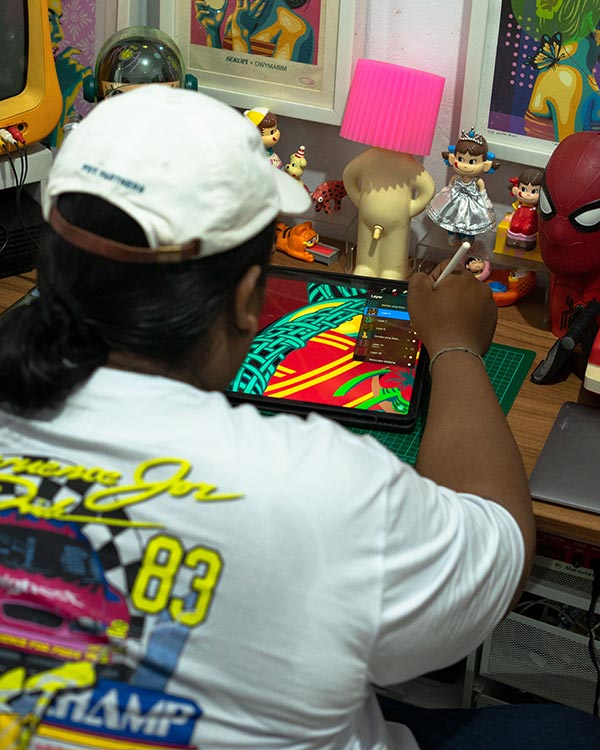
In Bali’s ever-evolving visual landscape, where tradition and modernity constantly intersect, Dwymabim emerges as a compelling voice—one that quietly reshapes how the island is seen, felt, and remembered. Born in Tabanan in 1995, his journey into art began not within the walls of galleries, but on the open surfaces of public space. Streets, walls, and urban corners became his first canvas, long before his work found its way into more curated environments.
This origin is essential to understanding his practice. There is an immediacy in Dwymabim’s work—a sense that it belongs to the public, to everyday life. Yet, over time, his visual language has evolved into something more refined without losing that raw emotional core. Today, his murals and compositions exist in a unique space: where street art meets hospitality, where spontaneity meets intention.
The Balinese Woman Reimagined
At the center of his work lies a recurring figure—the Balinese woman. Not portrayed as an object of spectacle, but as a symbol layered with meaning: softness and resilience, tradition and transformation, presence and memory. His interpretation often leans toward the romantic, yet it is never simplistic. Instead, it becomes a way of re-seeing femininity within a cultural context that is both deeply rooted and continuously shifting.
A Contemporary Visual Language
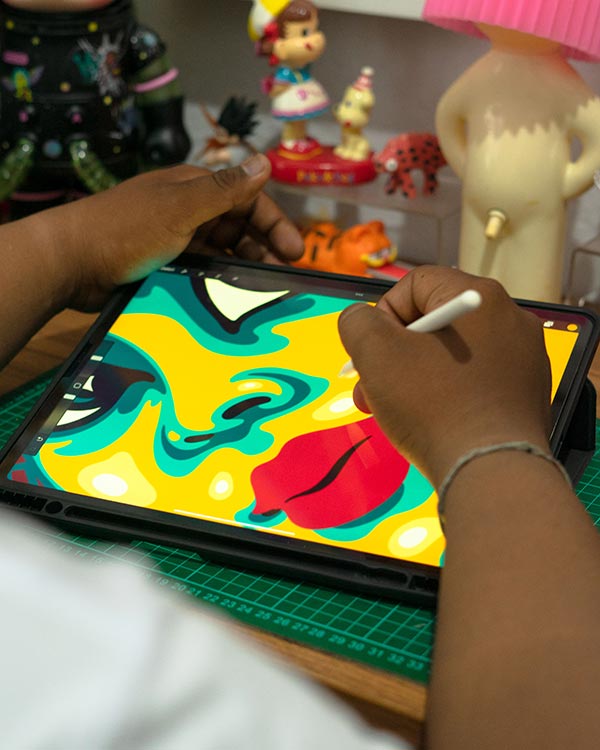
Visually, Dwymabim’s style is unmistakable. Clean vector lines meet bold color palettes, creating compositions that feel both contemporary and timeless. Traditional motifs are not replicated, but reimagined—distilled into forms that resonate with a younger, global audience while still holding onto their cultural essence. It is this balance that allows his work to move fluidly across different spaces, from the streets of Bali to high-end hospitality environments.
Art as Social Reflection
Beyond aesthetics, his practice is also grounded in a broader social awareness. Through his involvement with collectives and exhibitions that address issues such as mental health and domestic violence, Dwymabim positions art as more than visual expression—it becomes a platform for dialogue. In this way, his work carries a dual presence: it invites admiration, but also reflection.
From Street to Stillness
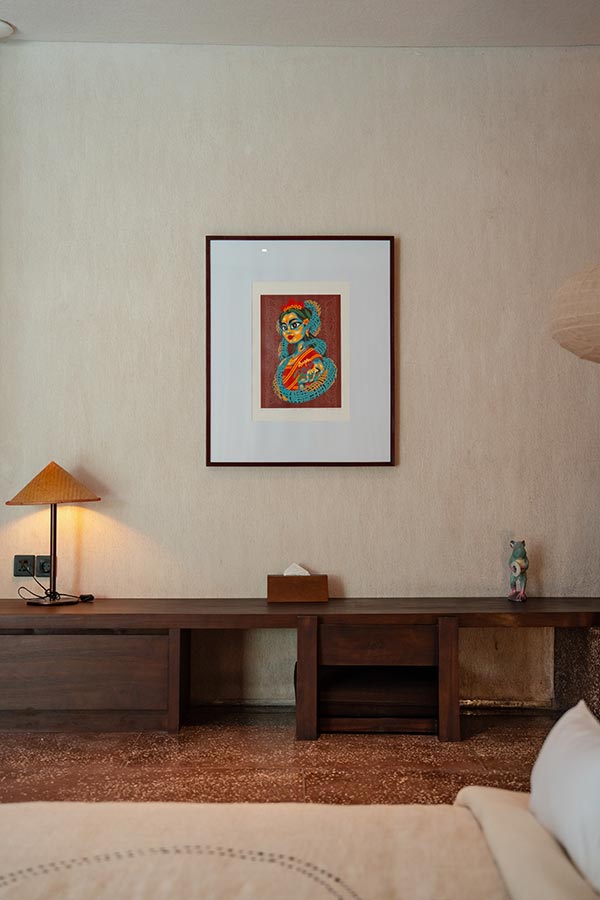
At The Craft Hotel, this duality becomes particularly significant. Removed from the unpredictability of the street, his work takes on a different rhythm—quieter, more contemplative, yet no less powerful. Here, it interacts with architecture, light, and material, becoming part of a larger sensory experience. Guests encounter his visuals not as isolated artworks, but as integral elements of the space—subtle yet persistent in their presence.
There is something intimate about this shift. What was once encountered in passing is now experienced in stillness. The viewer is given time—to observe, to interpret, to connect. And within that time, the work reveals its layers: the interplay between tradition and modernity, the emotional resonance of its subjects, and the quiet strength embedded within its forms.
A Living Presence
Dwymabim’s trajectory reflects a broader movement within Bali’s creative scene—one that refuses to be confined by singular definitions. His work does not belong solely to street art, nor exclusively to contemporary fine art. Instead, it exists in between, occupying a space that is fluid, adaptable, and deeply relevant.
In many ways, his contribution to The Craft Hotel is not just visual—it is atmospheric. It shapes how the space feels, how it communicates, and how it invites engagement. Through his work, the hotel becomes more than a place to stay; it becomes a site of encounter, where art and everyday life intersect.
And perhaps this is where Dwymabim’s strength truly lies. Not in creating images that demand attention, but in crafting moments that linger—quietly embedding themselves into memory, long after the viewer has moved on.
Experience the Work
Dwymabim’s works are part of the living collection at The Craft Hotel, woven into the spaces you move through, the corners you pause in, and the moments you take for yourself.
To fully experience his work is not simply to view it, but to stay within it where art, space, and atmosphere come together as one.
Discover it in person, through your stay with us.